

The efficiency case for AI in L&D is easy to make. Content development time drops. Updates take hours instead of weeks. First drafts that used to require half a day get generated in fifteen minutes. The business case practically writes itself, and leadership often approves it. What comes next is less frequently discussed.

If your team recovers significant capacity through AI, what do you do with it? The answer that comes automatically (take on more work, clear the backlog, deliver more projects) is logical. It is also a choice, and not always the right one. There is another use of recovered time. It does more for the L&D function’s long-term influence and organizational impact.
The distinction between those two paths is the argument this post is making. It is not a criticism of efficiency as a goal. Efficiency is a means. The end it serves depends entirely on what you do with the capacity it creates.
AI efficiency in L&D is the opportunity. What you do with that opportunity is the strategy question, and it does not have an automatic answer. I covered the broader picture in AI in L&D for Enterprise.
Two Ways to Spend Recovered Time
When AI reduces the time a team spends on content development, that time can go one of two places.
The first is throughput. More courses. More updates. More requests fulfilled. The team produces more output in the same amount of time, or the same output with fewer resources. The work looks the same; there is just more of it. This is the most natural default because it is the most visible. The backlog clears, stakeholders see deliverables, and the team appears more productive by any conventional measure.
The second is function impact. It maps onto the distinction I drew in Two Ways to Use AI in L&D: producing content versus building capability. Here the team uses recovered capacity for work that was previously crowded out: deeper needs analysis before accepting a project, more rigorous evaluation after a program launches, closer partnership with business units on the performance problems that learning alone cannot solve, better data on what is actually working and why. The output may not look more impressive on a project tracker. But the work is harder, more strategic, and more directly connected to outcomes that matter to the organization.
Neither path is the wrong answer
Throughput is not a lesser choice. Clearing a backlog that has frustrated stakeholders for years has real value. A team that produced nothing but function impact work, with no visible output, would not last long in most organizations. These are not a hierarchy of virtue. They are different bets on what the function needs most right now.
Both paths use the same recovered capacity, and both can be legitimate. What changes the function’s trajectory is whether the choice gets made on purpose.
What ‘30% Faster’ Actually Looks Like in Practice
Consider a hypothetical scenario. It is modeled on what is realistic in a mid-sized enterprise L&D team rather than drawn from a single published study. Three instructional designers, each developing four to six courses per year. Say AI-assisted development cuts their per-course time by roughly 30 percent across first drafts, storyboarding, and initial sourcing. The math is not trivial. Across the team, that could translate to somewhere between 300 and 450 hours of recovered capacity per year.
In this model, three hundred to four hundred fifty hours is meaningful. Here is how that hypothetical capacity might get spent in two different scenarios.
Throughput scenario
The team takes on three to four additional projects per year. A backlog that has existed for years finally gets addressed. Stakeholders who have been waiting months for L&D support now get a response. The team delivers more, the department looks more capable, and leadership is satisfied. At the end of the year, the team has produced 15 to 20 percent more content than the year before.
What has not changed: the quality of the needs analysis that precedes each project, the depth of the evaluation that follows it, the team’s understanding of whether any of the training actually changed behavior or moved a business metric, and the degree to which L&D counts as a strategic partner rather than a production function.
Function impact scenario
The team takes on one additional project. The remaining recovered capacity goes into three things:
- A structured intake process that assesses whether requested training actually addresses a performance problem, and redirects non-training requests before content development begins.
- A Level 2 and Level 3 evaluation process for the three programs with the highest organizational visibility.
- A quarterly meeting with business partners to review what the data is showing and where the real performance gaps are.
At the end of the year, the team has produced roughly the same volume of content as the year before. But it has redirected two projects that would have been training solutions to non-training interventions. It has data showing that one high-investment program is not producing behavior transfer, and a redesign is underway based on that evidence. Business partners are asking L&D into conversations earlier because the function is showing up with analysis, not just deliverables.
Same hypothetical capacity. Dramatically different outcome for the function’s organizational role in each path. The difference is in the choice, not in the efficiency gain itself.
Why L&D Teams Default to Throughput
The throughput default is not irrational. There are structural and cultural reasons it happens, and understanding them is necessary for choosing differently.
Stakeholders ask for deliverables
Most L&D teams receive requests in the form of content needs: a course on this topic, an update to that module, a new onboarding experience for this role. The demand signal is for production output, not for performance consulting or evaluation analysis. Teams that respond to demand signals will naturally optimize for throughput, because throughput is what stakeholders are requesting.
Capacity is easy to fill
In most organizations, the list of L&D requests significantly exceeds the team’s capacity to fulfill them. Recovering time means the backlog can move. There is rarely a conversation about whether the backlog should move. Do all of those requests represent real performance problems that training can solve? Or do some of them represent stakeholders solving the wrong problem?
Function impact work is harder to measure
Delivering a course produces a measurable output. Running a rigorous needs analysis that results in recommending against a course is harder to count. A Level 3 evaluation showing that behavior transfer is not happening is genuinely valuable. It also requires follow-through, stakeholder cooperation, and the willingness to surface findings that may be uncomfortable. Throughput is easy to track. Function impact is harder to demonstrate, which makes it harder to defend at budget time.
The identity of the function
In many organizations, L&D is still primarily understood as a content production function. That identity shapes what gets resourced, what gets measured, and what gets asked for. Teams that have operated as a production function for years do not automatically shift into performance consulting. Some available capacity does not change that. The identity has to change first, and that is harder than adopting a new tool. I mapped those conditions out in What AI Readiness Actually Means.

What Advancing Function Impact Actually Looks Like
This is not abstract. There are specific things L&D teams can do with recovered capacity that move the function in a more impactful direction. None of them require adding headcount or fundamentally restructuring the team.
Rigorous intake and needs analysis
A structured intake process that asks ‘is this actually a training problem?’ before a project starts is one of the highest-leverage investments a team can make. Most performance gaps are not primarily knowledge gaps. They involve motivation, environment, tools, management practices, or processes. Identifying non-training causes early prevents the team from building solutions that will not work. It also positions L&D as a diagnostic resource rather than an order-taker. The time this requires is real. AI efficiency can create the space for it.
Evaluation that closes the loop
Most L&D teams collect Level 1 data: reaction surveys, completion records. Fewer collect Level 2 data on actual learning. Fewer still follow up at Level 3, to assess whether learners are applying what they learned on the job. Fewer again reach Level 4 and connect training to business outcomes. The reason is not that teams do not care about these things. It is that evaluation takes time, requires coordination with managers and business units, and competes with current project demands. Recovered capacity is a genuine opportunity to close that loop on high-visibility programs.
Analytics that connect to business metrics
Enrollment and completion data are what most L&D teams report. That data tells you about program activity, not program impact. Recovered capacity can go into measurement frameworks that connect learning data to business performance data: productivity, error rates, customer satisfaction, time-to-competency, retention. This is the work that changes how leadership thinks about L&D. It takes time to set up, requires relationships with data and business intelligence teams, and does not produce immediate visible deliverables. That is exactly why throughput crowds it out.
Strategic partnership with business units
Some L&D teams get asked to build content. Others get a seat at the table while business decisions are still being made. The difference is often whether business leaders see L&D as a capability partner or a production vendor. Building that relationship requires consistent presence in business unit conversations. It requires enough understanding of business priorities to speak that language. It also requires the ability to surface insights from learning data that are relevant to business problems. Regulated environments add another layer, which I covered in AI in Compliance-Driven Training. None of that is possible when the team is at full production capacity with no room for anything else.
The Language to Take to Stakeholders
Choosing function impact over throughput usually requires a conversation with the people who fund and evaluate L&D. That conversation needs language that resonates with business priorities, not L&D theory.
The throughput argument is simple: AI lets us do more. Business leaders understand that argument immediately and reward it.
The function impact argument is harder but more durable. AI lets us do better work. That means catching the problems that would have wasted investment, identifying the programs that are not producing results, and getting ahead of performance gaps before they become business problems. Evidence for that argument accumulates over time. It has to be built intentionally, and it has to start with a choice about where recovered capacity goes.
What this sounds like in practice
With a CLO or business sponsor, the framing might be: ‘AI has reduced our per-project development time significantly. We have a choice about how to invest that recovered capacity. We can take on more volume, and we will, to a degree, or we can build in the evaluation and intake rigor that lets us demonstrate impact, not just activity. I’d like to discuss what that balance looks like for the next year, and what it would take to make the case for function impact in addition to throughput.’
That is a different conversation than ‘AI is helping us work faster.’ It is also a more strategic one. It positions the L&D leader as someone thinking about the function’s role in the organization, not just the function’s output.
How the evidence actually gets built
The CLO conversation only works if there is something behind it by the time someone asks. Three practices turn function impact from a talking point into a record stakeholders can check.
- Log every redirect. When intake catches a non-training problem before development starts, write down what the request was and what would have happened if the team had built a course anyway. After two or three quarters, those redirects are a case file, not an anecdote.
- Baseline before evaluating. A Level 3 finding only resonates if there is a before-and-after to point to: a measure taken ahead of the program and the same measure again six to twelve weeks later. Without that baseline, ‘this program is not changing behavior’ is an assertion, not evidence.
- Report on a fixed cadence, in business terms. A quarterly one-page summary, three to five data points tied to a business metric, sent to the same sponsor every quarter, builds more credibility over a year than one comprehensive report sent once.
None of this requires a research function. It requires deciding, before the next budget cycle starts, that the evidence will already exist when someone asks for it.
The business case for AI efficiency is easy to make. The business case for what you do with that efficiency is the one that determines whether the L&D function grows in influence or just grows in volume.
Recovered Time Is an Asset. Invest It Deliberately.
The AI efficiency gains coming to L&D teams are real. So is the choice about what to do with them.
As the earlier section noted, throughput is not wrong. Clearing backlogs and fulfilling requests faster are legitimate outcomes with real value to the organization. The issue is when throughput becomes the only answer to recovered capacity, by default rather than by design.
Teams that use AI to advance the L&D function’s organizational influence ask the harder question deliberately. They ask it before the capacity fills back up with the next wave of requests. What does the function need to do differently to demonstrate that learning investments produce business outcomes? Where does the existing evidence show that something is not working? Which intake and evaluation practices have been consistently crowded out that are now, finally, possible?
Those are the questions that turn AI efficiency into L&D impact. Answering them well is the real work.
Are you working through how to evaluate existing programs and build measurement practices that connect to business outcomes? The Program Evaluation and Audit work on the Work With Me page is where that conversation starts.
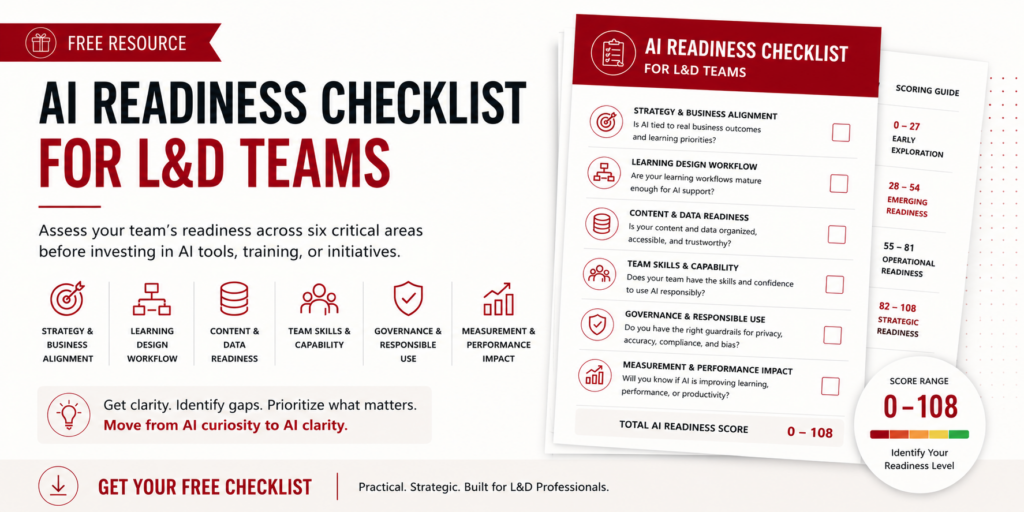
Want to assess your team’s overall readiness, including where AI fits into measurement and analytics? The free AI Readiness Checklist covers those dimensions directly.

