

There is a version of the AI-in-L&D conversation that gets had at conferences, in vendor webinars, and across LinkedIn. It is energetic, optimistic, and largely written by people who are not working in regulated industries. That version of the conversation is not wrong. It is just incomplete.
The moment your training program operates under regulatory oversight, whether that is FINRA, state insurance regulations, FDA requirements, or federal compliance mandates, the standard AI-in-L&D playbook runs into constraints that most advice does not address. Not because the tools are different. Because the environment is.

I work in a regulated environment. I have sat in the AI sessions, heard the productivity promises, and mentally run through the reasons my situation was more complicated before the speaker finished their second slide. The source content that requires legal sign-off before anyone can use it. The approval cycle that has never been fast and will not become fast because AI is now involved. The audit trail requirements that create accountability for every piece of content that reaches a licensed employee.
This article is for that practitioner: someone who needs the pattern named clearly. Not a verdict that AI is off the table. A clear account of what is actually different, and how to navigate it. If you want the broader picture of where AI genuinely helps enterprise learning teams, I covered that in AI in L&D for Enterprise: What Actually Works and What Does Not.
The Real Constraints in Regulated L&D
Most AI-in-L&D guidance rests on assumptions that are reasonable in a generic corporate learning context. None of them hold up once training operates under regulatory oversight.
Accuracy Is the Metric, Not Speed
In a general corporate context, AI that cuts development time in half is a clear win. In a regulated environment, speed is not the primary metric. Accuracy is. A compliance module that is produced quickly but mischaracterizes a disclosure requirement is not a productivity gain. It is a liability. The metric that matters is whether the content is correct, approved, and current, not how fast it was built.
Review Is Heavy, and the Risk Is Compliance, Not Just Quality
The standard advice is to generate a first draft with AI and have a human review it before publishing. In regulated industries, that review is not a light pass. It typically involves subject matter experts, compliance officers, and legal review, sometimes regulatory affairs as well. Their time is constrained and their standards are exacting, because the accountability is real. If an AI tool gives a registered representative incorrect product guidance, or generates content that mischaracterizes a suitability requirement, the issue is not a learner-experience problem. It is regulatory exposure. That changes the risk calculus, and it is why the review queue, not the drafting process, is usually the actual bottleneck.
Source Content Governance Is the Foundation
For AI tools that retrieve or generate content from existing materials, source content quality is everything. In large regulated organizations, that content is often distributed across systems, in different states of review, and inconsistently version-controlled. Layering AI on top of that kind of content ecosystem does not fix it. In some cases, it surfaces the disorganization faster, and at a scale that creates more risk, not less.
Disclosure and Audit Trail Obligations Are Design Requirements
Many regulated industries require training content to state specific things explicitly: disclosures, caveats, regulatory citations, approved language. AI tools generating content are not inherently aware of those requirements, and their output may omit a required disclosure or use unapproved language without any signal that something is missing.
On top of that, regulated industries typically need to document what training employees received, when, and that the content itself was reviewed and approved by the right people. FINRA Rules require member firms to maintain records documenting both the content of their training programs and completion by registered persons. When AI generates or modifies that content, the documentation gets more complex: who reviewed the output, what it was based on, when it was approved, and what version is current. None of that has an automatic answer. It has to be built into the workflow deliberately.
Where This Breaks Down in Practice
With those constraints in mind, four failure patterns show up most consistently when AI is adopted in regulated L&D without accounting for them.
1. Content Generation Without Approved Source Material
Asking an AI tool to generate compliance content without a tightly governed set of approved source materials is the most common failure point. The output sounds authoritative, does not flag its own uncertainty, and ends up requiring more expert review than writing the content from scratch would have. The speed advantage disappears. The review burden increases, because reviewers now have to evaluate AI-generated content against approved standards instead of editing a familiar draft they helped shape.
2. Knowledge Retrieval on Ungoverned Content
AI-powered knowledge bases and retrieval tools are genuinely valuable, but only when the content they draw from is current, approved, and organized. In regulated organizations where content lives across multiple systems in various states of review, a retrieval tool surfaces whatever it can find. If that includes outdated policy or draft content that was never approved, the tool is not helping someone find the right answer. It is helping them find an answer. In a regulated environment, that distinction has consequences.
3. Mismatched Timelines Between AI Speed and Approval Cycles
AI accelerates production. Approval cycles in regulated industries cannot accelerate at the same rate without creating risk. The result is a mismatch: teams can produce more content than the review pipeline can absorb. That does not improve time to publication. It creates a larger queue, increases reviewer workload, and can lengthen the overall development cycle by making review the bottleneck instead of just a constraint.
4. Confidence Without Accuracy
This is the most dangerous pattern. AI systems produce output in a consistently confident register regardless of whether the content is accurate. FINRA names this directly in its 2026 Annual Regulatory Oversight Report, describing hallucinations as output that is inaccurate or misleading yet presented as factual, and flagging the risk of misrepresenting or incorrectly interpreting rules, regulations, or policies.
In a low-stakes domain, that is manageable: reviewers catch the errors. In a domain where accuracy carries regulatory weight, a reviewer who is under time pressure, unfamiliar with a specific requirement, or simply trusting that AI would not state something incorrectly with such confidence, can pass content that contains a material error. The cost of confident wrongness in a regulated environment is not reputational. It can be a regulatory action, a client harm event, or legal liability. That requires a different review standard than does this look right.
A Practical Frame: Match Your Governance to Your Risk Level
The underlying principle for AI adoption in regulated L&D is proportionality. Not every use case requires the same level of oversight, and a blanket policy that either blocks everything or approves everything misses the point. The governance structure should reflect the actual risk of the content.

A practical way to think about this:
- Low-risk content: internal operations, process documentation, practice scenarios. Lighter review, faster iteration, a reasonable starting point for AI adoption.
- Medium-risk content: general professional development, non-product onboarding, manager training. Standard SME review, a compliance spot-check, documented approval.
- High-risk content: product training, compliance requirements, regulatory guidance, client-facing scripts. Full legal and compliance review, documented version control, explicit source attribution, regular accuracy audits.
Building the Tiers Into the Workflow
The AI tools and workflows used for each tier can differ. A high-risk workflow might use AI only for initial structuring and outlining, with every substantive claim coming from approved source material and every draft going through legal and compliance review. A low-risk workflow can use AI more extensively with a lighter standard. What matters is that the distinction is explicit and enforced, not left to individual practitioners to work out case by case.
This also means governance has to be built into the AI adoption process from the start, not retrofitted after the first error surfaces. In regulated industries, governance is not overhead. It is the condition that makes AI trustworthy enough to use at scale. The organizational conditions that make this possible are the same ones I mapped out in What AI Readiness Actually Means for Enterprise L&D Teams.
The teams that get AI right in regulated L&D are not the ones that moved fastest. They are the ones that built the right guardrails first, then moved with confidence inside them.
What Actually Works: Lower-Risk Entry Points for AI in Regulated Environments
None of this means AI has no place in regulated L&D. It means the entry points need more care than a generic adoption guide suggests. The lower-risk applications below map to the low end of the tiering frame above: less regulatory exposure, more human review in the loop, or content that does not directly shape what a licensed professional tells a client.
Administrative and Operational Content
System training, process documentation, onboarding logistics, and internal operational content carry meaningfully lower regulatory risk than product, compliance, or client-facing training. These are reasonable starting points for AI-assisted development. The accuracy stakes are lower, the approval process is lighter, and the feedback loop is faster, which lets teams build comfort with AI workflows before applying them to higher-risk content.
Practice Scenarios and Simulated Conversations
AI-generated practice scenarios, where employees rehearse conversations or apply concepts in a simulated environment, carry lower risk than AI-generated instructional content, because the practice environment is not the authoritative source of regulatory truth. A conversation simulation where a financial advisor practices explaining a product to a hypothetical client is less risky than AI-generated content meant to accurately describe that product’s approved features. The scenarios can be reviewed at a lighter standard, and the value, confident and practiced performance, is real.
Internal Drafting Support for High-Volume, Low-Stakes Content
AI works well for generating first drafts of content that will receive thorough expert review regardless. Manager communications, learning pathway descriptions, facilitator prep guides, and job aids for non-regulated processes can benefit from AI-assisted drafting without significantly increasing regulatory risk, provided the review process stays in place.
Supporting SME Time, Not Replacing SME Review
One of the more productive framings for AI in regulated L&D is this: AI should make it easier for subject matter experts to contribute their knowledge, not bypass their review.
This is not a theoretical recommendation. In its 2026 report, FINRA identified summarization and information extraction as the single most common generative AI use case among member firms. The industry has largely converged on using AI to condense and organize existing material rather than to originate regulated content.
AI tools that help SMEs structure their input, generate interview questions for knowledge capture, organize SME-provided content into usable formats, or summarize complex source material into draft learning content can reduce SME burden while keeping expert review at the center of the process. That is exactly where it belongs in a regulated environment. It is also the distinction I drew in Two Ways to Use AI in L&D: the difference between using AI to produce content and using AI to support capability.
The Regulated Environment Is a Feature, Not a Bug
Working in a regulated industry is a real constraint. Approval cycles are slower. Review standards are higher. The consequences of error are more significant. None of that goes away because AI is now part of the toolkit.
But the discipline that regulated environments require is also the discipline that makes AI adoption more durable and more defensible: clear governance, approved source content, documented accountability, and rigorous accuracy standards. Organizations that build those foundations are not just complying with regulations. They are building the conditions that make AI genuinely trustworthy.
The generic AI-in-L&D playbook was not written for this environment. That is not a criticism of that work. It is an observation about scope. Regulated industry practitioners need a more specific frame, grounded in the actual constraints of their context.
Getting AI right in regulated L&D is harder than the generic playbook admits. It is also worth doing well: the learning function, the organization, and the employees who depend on accurate training all benefit when it is.
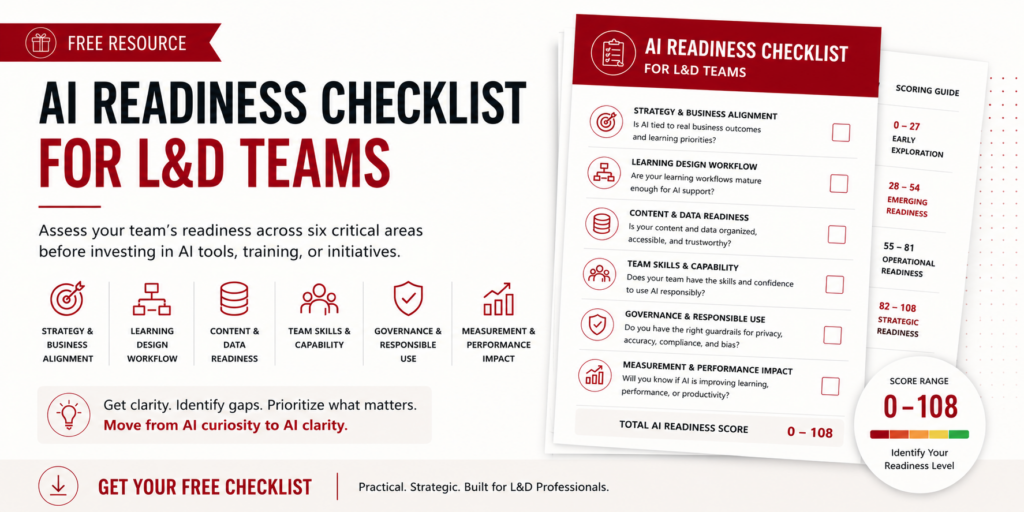
If you already know your constraints and need help building the actual governance tiers for your environment, the Work With Me page covers that kind of advisory work. If you are still mapping where your gaps are, the free AI Readiness Checklist was built with regulated environments specifically in mind. It is the place to start before your next AI investment.