I recently completed ATD’s Applying AI in L&D Certificate, and it gave me a useful moment to pause and reflect. Not just on what AI can do for Learning and Development, but on where the real value actually sits. Because right now, AI is everywhere in L&D.
Every vendor has an AI feature. Every conference has an AI session. Every learning team is being asked how they are using it. And while the energy is exciting, it also creates a lot of noise. The more I learn, test, and apply AI in real enterprise learning work, the more convinced I am of this:
AI will not fix a weak learning strategy.
It can make a strong strategy faster, smarter, and more scalable. It can help teams move from static training to performance support. It can help employees practice, reflect, find trusted answers, and build confidence closer to the moment of need. But if AI is only being used to produce more courses, more summaries, more quizzes, and more generic content, then we are missing the bigger opportunity.
For enterprise L&D teams, especially in financial services and insurance, the question should not be: “How can we use AI?”
The better question is: “Where can AI help people perform better, make better decisions, and build capability faster?” That shift matters.
The World Economic Forum reports that employers expect 39% of workers’ core skills to change by 2030. In insurance and pensions management specifically, curiosity and lifelong learning, resilience, flexibility, and agility are ranked especially high as core skills. That is a major signal for our industry. The work is changing, and learning cannot stay locked inside traditional programs. LinkedIn’s Workplace Learning Report also shows that nearly half of learning and talent development professionals say executives are concerned employees do not have the right skills to execute business strategy.
That is exactly where L&D needs to become more strategic. AI is not just a tool conversation anymore.
It is a capability conversation.
BUT Before You Add Another AI Tool, Assess Your Readiness!
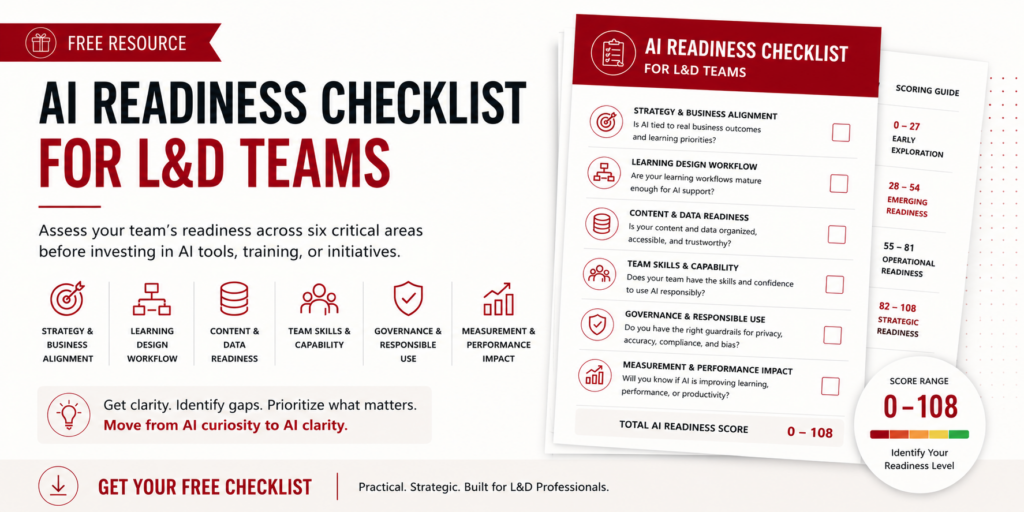
Before learning teams invest more time, tools, or budget into AI, they need to understand where they actually stand. That is why I created the AI Readiness Checklist for L&D, a free resource designed to help learning teams assess where they are across six areas:
- Strategy
- Workflow
- Content
- Capability
- Governance
- Measurement
The goal is simple: help L&D teams move beyond experimentation and make smarter decisions about where AI belongs in their learning ecosystem. Because AI readiness is not just about whether your team has access to tools. It is about whether your team has the strategy, workflows, skills, governance, and measurement discipline to use those tools well. That matters even more in regulated industries like financial services and insurance, where accuracy, compliance, trust, and learner confidence are not optional.
The Real Opportunity: Move From Content to Capability
For years, L&D has been measured by what it produces. Courses. Programs. Job aids. Completion rates. Curricula. Those things still matter, but they are not enough. Enterprise learning needs to move toward capability systems. That means creating learning environments that help people perform before, during, and after the moment of need.
In practical terms, AI can help L&D support:
- faster access to trusted information
- better practice before high-stakes conversations
- more personalized learning paths
- stronger coaching support for managers
- better visibility into skill and knowledge gaps
- faster updates when products, policies, or regulations change
This is especially important in financial services and insurance because the work is complex. Employees need to understand products, client needs, compliance expectations, systems, and business priorities. They also need judgment. That last part is critical.
AI can support judgment, but it should not replace it.
In financial services, the cost of misinformation can be high. A poorly designed AI assistant, chatbot, or learning tool could give inaccurate product guidance, oversimplify compliance requirements, or create false confidence in a learner who still needs coaching. That is why AI in L&D for enterprise needs to be designed with intention. Not just speed. Not just scale. Not just novelty.
What AI Is Actually Good For in L&D
AI works best when it reduces friction in the learning and performance process. It is not magic. It is not a strategy by itself. But when applied well, it can make learning more relevant, more accessible, and more connected to real work.
For enterprise L&D teams, I see three areas where AI can create meaningful value:
- Content operations
- Knowledge access
- Coaching and practice
Each one matters, but they are not equal.
1. Content Operations
This is the most obvious use case. AI can help draft, summarize, rewrite, repurpose, and organize content. It can turn a long SME document into a first draft. It can create role-based variations. It can help convert source material into microlearning, scenario prompts, practice questions, manager guides, and communications. That is useful. But content creation is not the highest-value use case on its own. The danger is that L&D teams use AI to create more content without asking whether the content is solving the right problem.
More content does not automatically create more capability.
In many enterprise organizations, the problem is not lack of learning content. The problem is that employees cannot find what they need, do not know what matters most, or do not have enough support applying it. AI can help with content operations, but it should not turn L&D into a faster content factory.
The better use of AI is to reduce the administrative burden so learning teams can spend more time on analysis, design, stakeholder alignment, practice, and measurement. The win is not:
“We made a course faster.”
The win is:
“We helped people get ready faster.”
That distinction matters.
2. Knowledge Access
This is where AI can become extremely valuable. In large organizations, people often waste time searching for the right answer. They look through SharePoint folders, intranet pages, policy documents, job aids, emails, and recorded meetings. Sometimes they ask five different people and still do not know which answer is current. AI can help organize and retrieve trusted information faster.
Morgan Stanley’s use of AI in wealth management is a strong example. The firm embedded GPT-4 into advisor workflows to help financial advisors access internal knowledge and respond to client needs. OpenAI reported that more than 98% of advisor teams use the AI assistant, with document access increasing from 20% to 80%. That is not just a technology story. It is a learning story. When employees can find trusted answers faster, they can spend more time applying knowledge, serving clients, and making better decisions.
For insurance and financial services teams, this is a major opportunity. Think about how often employees need to understand:
- product updates
- policy changes
- regulatory guidance
- planning concepts
- suitability considerations
- underwriting rules
- advisor-facing resources
- service procedures
- client conversation guidance
AI can help people get to the right information faster, but only if the information is well-governed, current, and approved.
Garbage in still means garbage out.
This is where many AI pilots fail. The tool may be impressive, but the knowledge ecosystem behind it is messy. If source content is outdated, duplicative, unapproved, or buried across multiple systems, AI will not magically solve the problem. In some cases, it will make the problem more visible. That can actually be useful, but only if the organization is ready to address it.
3. Coaching and Practice
This may be one of the strongest areas for AI in L&D. People do not build confidence by reading more content. They build confidence through practice, feedback, repetition, and reflection. AI can help create safe practice environments where employees can rehearse real conversations before they happen.
New York Life is already using AI this way. Its University uses AI-powered conversation simulators to help employees practice client interactions and receive real-time feedback. That matters because practice is often the missing layer in corporate learning.
We tell people what to know. We give them a module. Maybe we add a quiz. Then we expect them to perform in a live conversation with a client, manager, or stakeholder. That is not enough.
For financial services and insurance, AI-supported practice could help with:
- client discovery conversations
- objection handling
- planning conversations
- compliance-sensitive scenarios
- manager coaching conversations
- service recovery
- explaining complex products in simple language
- practicing difficult stakeholder conversations
- preparing for role-specific performance expectations
This is where AI becomes more than a productivity tool. It becomes a readiness tool. That is the real opportunity for enterprise L&D. Not just helping people complete learning faster, but helping them become more capable before they are expected to perform.
Where AI Fails
AI fails when organizations use it without clear thinking. The most common mistake is treating AI as a shortcut instead of a system.
That usually shows up in four ways.
1. AI Fails When It Creates More Noise
If AI helps L&D create 50 new assets that nobody needs, that is not innovation. That is clutter. Many learning teams already have too much content. The problem is not always lack of material. The problem is that employees cannot find what they need, do not know what matters, or do not have enough practice applying it. AI can make this worse if teams use it to mass-produce content without a clear performance goal.
Before creating anything with AI, L&D should ask:
- What business problem are we solving?
- What does the learner need to do differently?
- Where is the performance gap?
- What support is needed in the workflow?
- How will we know this worked?
If those questions are not answered, AI will only help us move faster in the wrong direction.
This is especially important in enterprise environments where learning teams support multiple audiences, business units, product lines, and compliance needs.
More content can create more confusion.
More relevance creates more value.
2. AI Fails When It Replaces Thinking
There is a real risk that people use AI to complete work without learning from the process. This matters for L&D. If employees use AI to draft, summarize, answer, and decide without reflection, they may appear more productive while actually building less capability. That is a dangerous tradeoff. The goal should not be to remove effort from learning. The goal should be to focus effort where it matters most. AI should help learners think better, not think less. A strong AI-enabled learning experience should ask people to compare, critique, explain, apply, and reflect. It should create better practice, not just faster answers.
For example, instead of giving a learner the answer to a client scenario, an AI coach could ask:
- What is the client really asking?
- What information do you still need?
- What risk or compliance considerations should you keep in mind?
- How would you explain this in plain language?
- What would you say next?
That is learning. That is performance support. That is capability building.
3. AI Fails When It Is Not Grounded in Trusted Sources
This is especially important in regulated industries. AI can sound confident even when it is wrong. That creates risk in financial services and insurance, where accuracy matters. If an AI tool gives incorrect guidance about a product, policy, compliance requirement, or client scenario, the issue is not just a learning issue. It can become a business risk. That is why AI tools in enterprise learning need governance. They need approved sources. They need human review. They need clear boundaries. They need escalation paths. They need regular evaluation.
This does not mean every AI use case needs to be slow or overcomplicated. It means the level of governance should match the level of risk. A tool used to brainstorm internal workshop activities is not the same as a tool used to support advisor guidance or client-facing conversations.
Enterprise L&D teams need to understand that difference.
4. AI Fails When Leaders Treat It Like a Tool Rollout
This may be the biggest issue. AI adoption is not just a technology rollout. It is a behavior change effort. Employees need to know how to use AI responsibly. Managers need to know how to coach AI-enabled work. Leaders need to know where AI fits into business strategy. LinkedIn reports that 71% of L&D professionals are exploring, experimenting with, or integrating AI into their work. That is encouraging, but experimentation alone is not enough.
Enterprise teams need structure.
They need a clear point of view on what AI should and should not do. They need practical use cases. They need governance. They need measurement. They need examples that connect directly to work. Otherwise, AI stays in the “interesting experiment” category. And that is not enough anymore.
What Enterprise L&D Should Prioritize
For enterprise teams, the priority should not be building an AI course catalog. The priority should be building AI-enabled capability systems. Here is what that means.
Start With Real Work
Look at the moments where employees struggle.
Where do they hesitate?
Where do they ask the same questions repeatedly?
Where do managers spend too much time correcting mistakes?
Where do clients experience inconsistency?
Where does compliance risk increase?
Where does readiness take too long?
Those are better starting points than: “Let’s create an AI training.”
In financial services and insurance, this could include onboarding new advisors, preparing agents for client conversations, helping managers coach performance, supporting employees through product and policy changes, or improving readiness for new systems and tools.
The closer AI is to real work, the more useful it becomes.
Build Practice Into the Flow
AI should help employees practice before they perform. That could mean client conversation simulations, branching scenarios, role-play coaching, reflection prompts, or guided feedback. The best use cases are not always the flashiest. They are often the ones closest to real performance.
This matters in insurance and financial services because so much of the work depends on conversation quality, judgment, trust, and confidence. A learner may understand a product concept in theory but still struggle to explain it clearly to a client. A manager may know they should coach but still struggle to structure the conversation. An advisor may complete required training but still hesitate during a planning discussion.
AI-supported practice can help close that gap.
Use AI to Support Managers
Managers are often the missing link in learning transfer. They are expected to coach, reinforce, and support behavior change, but they often lack the time or tools to do it consistently. AI can help managers prepare for coaching conversations, identify patterns, summarize progress, and recommend follow-up actions.
This is not about replacing managers. It is about helping them show up better.
For enterprise L&D, manager enablement should be a major AI priority. If managers are not equipped to reinforce new behaviors, even the best-designed learning programs will struggle to create sustained impact.
Connect Learning to Skills
Enterprise L&D needs to get closer to skills data. Not just course completions. Not just attendance. Skills.
What capabilities does the business need?
Where are the gaps?
Which roles are changing?
What skills are becoming more important?
What learning experiences actually move people closer to readiness?
The World Economic Forum notes that AI and big data, analytical thinking, creative thinking, resilience, and technological literacy are expected to become even more important by 2030. For insurance and pensions management, creative thinking and curiosity are also growing in importance.
That is a signal for L&D leaders. The future is not only technical. It is human plus technical.
Enterprise learning teams need to help employees build both.
Measure What Matters
Completion rates are not enough. Enterprise L&D should measure whether AI-enabled learning improves:
- time to proficiency
- confidence in role-critical tasks
- quality of client conversations
- manager coaching consistency
- speed to find trusted information
- readiness for new products, tools, or regulations
- reduction in repeated questions or avoidable errors
- ability to apply knowledge in real scenarios
This is how L&D becomes more credible with senior leaders.
The conversation has to move from: “How many people completed the training?”
to: “What changed because of the learning?”
That is where AI can help, but only if the measurement strategy is clear from the beginning.
What This Means for L&D Leaders
AI raises the bar for L&D. It does not lower it. The teams that will create the most value are not the ones that simply learn how to prompt better. Prompting matters, but it is not the whole strategy. The stronger opportunity is to rethink how learning is designed, delivered, supported, and measured.
That means L&D leaders need to ask more strategic questions:
- Are we solving the right performance problems?
- Are we using AI to support real work or just speed up content creation?
- Do we have trusted source material?
- Are managers equipped to support behavior change?
- Are we measuring readiness and performance, not just completion?
- Do we have governance in place before scaling?
These are not small questions. But they are the questions that will separate serious AI-enabled learning strategies from surface-level experimentation.
For financial services and insurance, this matters even more because the stakes are higher. The work is regulated. The products are complex. The client conversations matter. The need for trust is constant. That does not mean AI should be avoided.
It means AI needs to be applied with discipline.
The Bottom Line
AI in L&D works when it helps people perform better. It works when it supports practice, coaching, knowledge access, skills visibility, and faster readiness. It does not work when it becomes another way to produce more content without solving the real problem. For enterprise teams, especially in financial services and insurance, the opportunity is not to make learning look more modern. The opportunity is to make learning more useful.
The next phase of L&D will not be defined by who has the most AI tools. It will be defined by who can connect AI to capability, performance, and business outcomes. That is where L&D needs to go next.
Before you invest more time, tools, or budget into AI, start by understanding your current state. Download the AI Readiness Checklist for L&D to assess where your learning team stands across strategy, workflow, content, capability, governance, and measurement.
And if this perspective is useful, join the conversation on LinkedIn for more practical thinking on AI, enterprise learning, and the future of L&D.