

When most organizations ask whether they are ready for AI, they are really asking a narrower question: Have we purchased access to an AI tool? Do our employees know how to log in? Have we run a pilot?

Those are implementation questions. They are not readiness questions. And the gap between the two is where most enterprise AI investments in L&D go sideways. Here is the thing that took me time to see clearly working across enterprise learning programs, including in FINRA-regulated financial services environments: AI does not create favorable conditions for itself. It operates within the conditions that already exist. Speed amplifies what is already there.
A well-organized learning function with clear strategy, governed source content, and measurement discipline will get dramatically more from AI investment than one without those things. The reverse is equally true. If what is already there is misaligned, AI will help you produce more of it, faster, at higher volume.
That distinction matters in every enterprise L&D environment. It matters more in regulated industries (financial services, insurance, pharma, government) where the cost of AI gone wrong is not just a suboptimal learning experience. It can be a supervisory failure, an audit finding, or a compliance exposure that required human review at every step but did not get it.
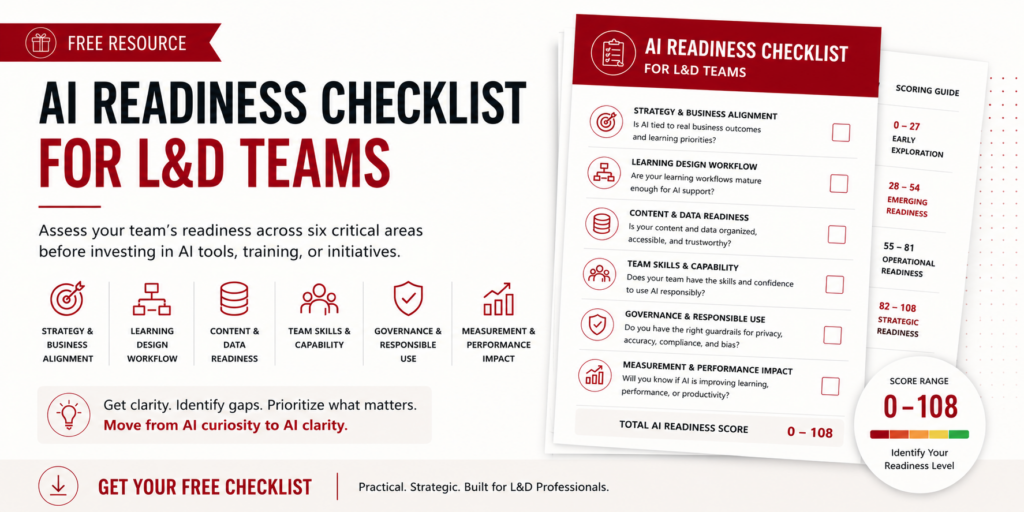
This post lays out six dimensions of AI readiness for enterprise L&D. I derived this framework from designing and advising on enterprise learning programs, particularly in regulated environments where skipping the diagnostic work showed up in consequences that were hard to ignore. The six dimensions are not a checklist to complete before you are permitted to use AI. They are a diagnostic, a way to see where your investment will create real value and where more tooling will compound existing problems.
Readiness Is About Conditions, Not Tools
The AI tools available to L&D teams today are genuinely capable, more accessible than they have ever been, and improving quickly. Access is no longer the constraint. The constraint is the organizational infrastructure that determines whether what those tools produce goes somewhere useful.
AI works well when the conditions around it are solid: a clear strategy for what AI should accomplish, workflows structured to absorb AI output, source content that is organized and governed, practitioners with the skill to evaluate AI judgment, governance processes that handle errors before they reach learners, and a measurement framework in place to tell signal from noise. When those conditions are absent, AI does not fix the problem. It accelerates whatever is already in motion.

The six dimensions below are not sequential, you do not complete one before starting the next. They are interdependent. Strategy without workflow integration creates a vision nobody can execute. Content governance without practitioner capability creates tools nobody trusts. Capability without governance creates risk that catches up with you. The diagnostic value is in seeing where you are across all six simultaneously.
Strategy Readiness
Do You Have a Point of View?
Strategy readiness is not a mission statement. It is not ‘we believe AI will transform learning.’ It is a specific, defensible position on what AI should and should not do in your learning ecosystem, grounded in the actual performance problems your organization faces.
A team that lacks a strategic position tends to adopt AI tools because a vendor demonstrated them, a peer organization announced them, or a senior leader heard about them at a conference. None of those are reasons connected to outcomes. The result is a tool that gets used for whatever it makes easiest (typically content production) without any clear account of what performance problem it is solving for. Twelve months in, the team has produced more content and has no answer when a stakeholder asks whether any of it moved the outcome it was aimed at.
A strategy-ready L&D function can answer specific questions: What performance problems are we solving with AI, and for which learner populations? What does AI replace versus augment, and where is human judgment non-negotiable? What is outside the scope of AI use in our context, and why? What does success look like in 12 months, in outcome terms rather than activity terms?
In financial services and insurance, strategy readiness requires one additional layer that most AI-in-L&D frameworks miss entirely: a specific position on compliance boundaries before tools go into production. What content categories can the learning function produce with AI, and what requires legal or compliance review before it reaches a learner? What supervisory training obligations (the kind governed under FINRA Rule or state insurance continuing education requirements) create an accuracy standard that AI output alone cannot meet? These are decisions that need to be made proactively and documented. The first error in a compliance-sensitive context is not the time to discover that no one made them.
Workflow Readiness
Can Your Processes Actually Absorb AI?
Most L&D processes were designed before AI existed. That is structural, not a criticism but it matters when you are trying to integrate AI into them. The question is not whether AI can theoretically speed up your workflow. It is whether your actual workflow, with its review steps, approval gates, SME access patterns, compliance checkpoints, and handoffs, is structured to benefit from what AI produces.
The most common failure pattern looks like this: AI accelerates content production, but SME review was already the constraint. Now there is more content to review, faster, and the queue that was manageable last quarter is backlogged this one. The tool made the throughput problem visible rather than better. In regulated environments, this compounds. A compliance review process designed for quarterly content releases is not built to process AI-generated content produced weekly and nobody thought to redesign it before scaling production.
Workflow readiness means understanding where AI fits in your current process, what new review steps it requires, and where friction is likely to appear before you scale adoption and discover those friction points under pressure. The teams that navigate this well typically run one workflow completely end-to-end before committing to AI at volume. The pilot is not just a tool proof-of-concept. It is a process stress test.
Content Readiness
Is Your Source Material Fit for Purpose?
This is the dimension that surprises most teams, because it does not feel like an AI question. It feels like a content management question. It is both, and failing to address it is one of the more consistent ways enterprise AI deployments create new problems rather than solve existing ones.
AI tools, whether generating content, retrieving information, or supporting employees in real time, are drawing from something. A script, a policy document, a knowledge base, a set of approved materials. The quality, currency, organization, and governance of that source material directly determines the quality of what AI produces.
Here is what this looks like in practice. A financial services training team deploys an AI performance support tool for financial professionals, surfacing product knowledge content at the moment of need. The product knowledge library has three versions of the same document: an original, an update from 18 months ago, and a draft that was never officially approved. The AI has no mechanism to determine which is current. The learners receive conflicting guidance depending on which version the system surfaces. What began as a productivity investment becomes a compliance review process. In a FINRA-regulated context, it can become something more serious.
Content readiness requires an honest inventory before AI deployment: what source materials exist, what state they are in, who owns them, who approves updates, and whether the governance structure can maintain currency over time. For many teams, this work surfaces a problem that predates AI entirely and that has to be addressed whether or not AI is in the plan.
Capability Readiness
Does Your Team Know How to Work With AI?
This is a different question from whether your team knows how to use AI tools. Most practitioners can log into a platform and generate a prompt. That is accessible and relatively low-barrier and it is not the capability that determines whether AI creates value or risk.
The capability that matters is evaluative: the ability to assess AI output quality, catch errors, recognize when a model is confident but wrong, and understand enough about how AI systems behave to make sound decisions about when to trust the output and when to override it.
Here is what that distinction looks like in practice. An instructional designer asks an AI tool to generate a scenario-based assessment for a compliance topic. The tool produces five scenarios. All five are grammatically correct, plausible in detail, and stylistically consistent. Four of them test whether the learner can recall a rule. One of them actually tests whether the learner can apply the rule under realistic conditions which is what the learning objective required. The ID without evaluative capability ships all five. The ID with it catches the four items that are knowledge recall dressed up as application, redesigns them, and has an informed conversation with the vendor about why the model defaults to recall. That is not a prompt engineering problem. It is a pedagogical judgment problem.
Building that evaluative capability takes deliberate investment, and it needs to happen alongside tool access not after the first round of errors surfaces in a review cycle. In regulated environments, the stakes are specific: an ID who cannot assess whether AI-generated compliance content is accurate and complete, not just fluent, is not in a position to sign off on it. The practitioner’s name is on that review. The capability has to match the accountability.
Governance Readiness
Do You Have the Oversight Structures in Place?
Governance is the set of decisions, processes, and accountability structures that determine how AI is used and how errors, risks, and edge cases are handled when they appear. It is not bureaucracy, and it is not a 50-page policy document.
The most important principle in governance design is proportionality: governance should be calibrated to the level of risk in the use case, not applied uniformly across everything. AI generating a first-draft job aid for an internal process is a different governance problem from AI generating content that meets a supervisory training obligation under FINRA, where the accuracy of that content is traceable in a regulatory examination. The first requires a human review step. The second requires a defined accountability structure: who reviews it, by what standard, with what documentation, and what the escalation path is when the content is inaccurate or outdated. Those are not the same answer.
Without governance, enterprise AI adoption tends toward one of two failure patterns. Teams become so cautious that AI never gets applied to anything consequential. Or teams move fast, learn from problems, and discover that some of those problems were easy to anticipate with a proportionate amount of upfront thinking. In a regulated environment, the second failure pattern has a third outcome: it shows up in an examination finding or an internal audit report.
Governance readiness means having clear ownership for four operational questions before you scale. Who is responsible for evaluating AI output quality before it reaches learners? What is the escalation path when AI produces inaccurate or outdated content? How are AI tools vetted for data privacy and accuracy before organizational adoption? How often are AI-enabled tools and content audited for ongoing relevance? These are not philosophical questions. They have owners, processes, and documentation, or they don’t, and that absence is itself a governance gap.
Measurement Readiness
Will You Know If It Is Working?
The last dimension is the one that determines whether AI adoption creates accountability or just activity. And it is the one most consistently skipped.
Measurement readiness means having a framework for evaluating whether AI is actually improving learning outcomes and not just whether it is being used. That distinction matters because usage data is easy to collect and easy to misread. The number of prompts run, the number of courses produced faster, the hours saved in authoring, these are throughput metrics. They do not tell you whether the learning function is more effective.
The questions that matter are outcome-oriented: Is time to proficiency improving in the roles where AI-enabled learning is deployed? Are learners more confident and better prepared for role-critical tasks before they perform them live? Are managers reporting better skill transfer and more consistent application of new behaviors? Are the same knowledge gaps reappearing, or is AI-supported learning actually closing them?
Measurement readiness also requires a baseline and this is where many teams discover a problem that predates AI. You cannot assess AI’s impact on time to proficiency if you did not measure time to proficiency before AI was in place. You cannot evaluate whether confidence improved without a pre-AI benchmark. L&D functions that have not been measuring outcomes rigorously will need to build that capability alongside their AI strategy. The alternative is reaching the point where a stakeholder asks whether the AI investment is working and having no credible answer. And that question will be asked.
Where Do You Actually Stand?
AI readiness is not a binary state. It is a spectrum across six dimensions and most enterprise L&D teams will find that they are further along in some areas than others. That is useful information, not a problem. Knowing where you actually stand is what tells you where to invest, not in more tools, not in faster content production, but in the conditions that determine whether AI makes your learning function genuinely more effective.
The dimensions compound. Strategy without workflow integration creates a vision nobody can execute. Workflow integration without content governance creates a faster path to surfacing bad information. Content governance without practitioner capability creates tools nobody trusts. Capability without governance creates risk that catches up with you. Governance without measurement creates accountability without insight. The organizations that get AI right in L&D are not the ones with the most tools. They are the ones that built the conditions first.
The AI Readiness Checklist for L&D Teams was designed to help enterprise learning teams assess exactly this across all six dimensions, with specific indicators for where you are and what needs attention before you scale. Especially if you are in a regulated industry where the stakes of getting it wrong are higher.
Start there. It is the most useful thing you can do before your next AI investment.

