

Every LMS generates it by default: percentage of learners who completed the course. Clean numbers, easy to read, easy to put in an executive report. The problem is not that the numbers are wrong. They are accurate records of who clicked through to the end. The problem is that completion records something that happened in the LMS. It says nothing about whether learning occurred, whether behavior changed, or whether the business problem has moved.

Most L&D leaders know this. Many report completions anyway, because it is what the system produces and because stakeholders have come to expect it. This post is about what completion data can and cannot support as a claim. Why teams default to it despite the limitations, and what a more defensible reporting approach looks like.
The argument is not against tracking completion. In mandatory training contexts, completion is a legitimate and necessary record: it tells you who received required training and when. The argument is against using completion as a proxy for learning effectiveness. Those are different claims, and completion data does not support the second one.
What Completion Data Actually Tells You
Completion tells you that a learner reached the end of a course. In a mandatory training context with LMS tracking, it tells you someone launched the module, moved through the required screens, and hit the completion trigger. That trigger might be a final assessment, a final slide, or a time threshold. For compliance that is a meaningful record. You can demonstrate that a specific individual completed a required training on a specific date.
What It Doesn’t Tell You
What completion does not tell you is almost everything else. Whether the learner paid attention. Retention, application, changed behavior on the job, or whether the training fixed the problem it targeted. A learner who clicks through a 30-minute compliance module in four minutes has ‘completed’ it. A learner who genuinely engaged with every scenario has also ‘completed’ it. Completion records only that the learner reached the endpoint.
This matters most when L&D uses completion data to claim learning effectiveness. ‘95% completion’ is evidence of 95% completion, not evidence of learning. When L&D presents completion as a proxy for program success, it makes a claim the data does not support. It also trains stakeholders to rely on a metric that cannot tell them what they need to know.
There is a useful distinction here between coverage and effectiveness. Completion tracks coverage: whether a training reached its intended population. Coverage is a legitimate thing to measure, particularly for required programs. Effectiveness measures whether the training produced its intended outcomes. These are related but different questions and conflating them is where completion reporting goes wrong.
Why L&D Teams Default to Completion Reporting
It would be easy to frame this as a failure of rigor or ambition. It is more accurate to understand it as a structural problem with four components.
First, completion is what the system produces automatically. Every LMS generates completion records by default. Generating Level 1 reaction data requires designing and deploying a survey. Generating Level 2 learning data requires designing assessments with the right fidelity. Level 3 behavior data need post-training follow-up, manager involvement, or observational data. The LMS produces none of that without additional design work. The path of least resistance is completion, because it exists without effort.
Second, stakeholders often ask for it. When a business leader asks ‘did they complete the training,’ a completion report is the answer. Most stakeholders have no reason to ask for anything else. L&D has not offered a better alternative in a form they can use. The pattern shows up in the industry data: ATD’s 2026 State of the Industry found that fewer than a quarter of organizations measure whether their training programs achieved their organizational goals, and a smaller share still measure ROI. Demand for completion data is partly a product of what L&D has historically supplied.
Third, the alternatives require more from L&D. Measuring behavior change requires a follow-up strategy and manager engagement. Measuring business results requires agreement on what outcomes to track and access to the data. These are harder conversations to have and harder data to collect.
A fourth reason: regulatory requirements
Fourth, and often decisive in regulated industries, completion is sometimes the literal compliance record. State insurance continuing education requirements and FINRA continuing education obligations are satisfied by a logged completion, not by a separate demonstration of learning. FINRA Rule 1240(b)(2)(C) is explicit: member firms must maintain records documenting the content of their training programs and completion by registered persons. In those contexts, completion is not a weak proxy L&D chose out of convenience. It is the actual regulatory deliverable. Effectiveness measurement runs alongside it as a parallel track, never as a replacement.
The structural pressure toward completion is real and understandable. That fourth reason shows it is sometimes a requirement rather than a choice. Understanding the structure is the first step toward changing what is changeable and reporting honestly about what is not.
A More Informative Hierarchy of Measurement
This connects to the measurement dimension of readiness I set out in What AI Readiness Actually Means. The Kirkpatrick model is over 60 years old and remains the most cited evaluation framework in L&D. Its structure is correct: there are four levels of evidence, and they are not equivalent. Reaction is the easiest to collect and the weakest evidence. Behavior changes and results are the hardest to measure and the most meaningful.
A later refinement, the New World Kirkpatrick Model, made the planning sequence explicit. Instead of starting with reaction and working up, it starts with the business result and the leading indicators that would demonstrate it. The program is then designed backward through behavior, learning and reaction. That backward-design sequence, not the four levels alone, is what makes this actionable rather than theoretical.
The practical question is not whether to always measure at Level 3 and 4. In many training contexts, the cost of that measurement exceeds the value of the information. The question is narrower. What level of evidence suits this type of training, and what is the minimum we should report to make an honest claim?

For mandatory compliance training
Completion is the appropriate primary metric: the goal is coverage, and completion tracks coverage. In regulated contexts such as state insurance CE credit or FINRA continuing education, completion is also the compliance record. It gets reported regardless of what else you measure. Where the curriculum allows, a brief knowledge check verifying minimum understanding strengthens the claim alongside that record. Reporting both gives a more defensible picture. Not ‘they completed it’ but ‘they completed it and demonstrated minimum understanding of X, Y and Z at the required standard.’
For skills-based training
Completion is close to useless as a primary measure. What you want is evidence the skill can be applied. Scenario-based assessment at an appropriate difficulty, manager observation, or performance data from the job context. If the training targets a specific performance metric, track it before and after. Close rate, quality score, error rate, with controls for other factors as practical.
For knowledge refreshers and informational content
Completion may be sufficient if the goal genuinely is ‘make this information available,’ not ‘change what this population does.’ The related question of what a regulated environment does to all of this is one I covered in What Nobody Tells You About AI in Compliance-Driven Training. But that goal should be stated explicitly, and the reporting should reflect it. ‘We made this available and 90% of the target population accessed it’ is an honest claim. ‘We trained 90% of the workforce on the new product release’ is a different claim that requires evidence of learning.
Reporting Differently to Stakeholders, How to Start
The most common reason L&D leaders keep reporting completion is uncertainty. How do you present something more informative to an audience comfortable with percentages? A few things are simultaneously true. Stakeholders are often more capable of interpreting nuanced data than L&D assumes. They are often asked to make decisions faster than thorough evaluation allows. And L&D has historically not given them better options.
Add One Number, Not a New System
The reframe that tends to work is additive. Rather than replacing completion with something more complex, add one data point that contextualizes it. ‘95% of your sales team completed the consultative selling course. Of those, 78% passed the scenario-based assessment at the threshold demonstrating they can apply the core skills in a realistic context. We are tracking a 90-day performance comparison against the prior cohort to assess behavior transfer.’ Three numbers, not one, and a substantially stronger claim.
Time the Conversation Before Design, Not After
L&D should have the conversation with stakeholders about what data to collect before designing a program, not after delivering it. Building measurement into the design process is what produces data worth reporting at the end. The key question to ask at the outset: ‘what evidence would tell us this worked?’ Retrofitting an evaluation strategy to a completed program produces weak evidence. Front-end evaluation design produces defensible evidence.
One practical framing for the stakeholder conversation: ‘We want to give you more useful information about whether the programs are actually working. It will look different from what you’ve seen before, and here’s what the new numbers mean.’ This framing positions the change as serving the stakeholder’s actual interest in knowing whether the investment is working. That interest is real.
What This Requires of L&D (Practically)
There are two practical changes that make this shift achievable for most L&D teams. Neither requires a new tool or a larger budget to start the conversation. What that conversation produces often does require real design time and sometimes new resourcing. A scenario-based assessment, a manager observation protocol, a tracked behavior metric. The conversation is cheap. Building what the conversation calls for is not. That distinction matters. This is a claim about where to start, not a claim that the whole shift is free.
The pre-design evaluation conversation
For any significant program investment, answer one question before instructional design begins: what evidence would tell us this worked? A new course, a major curriculum revision, a new onboarding track. That sequencing, defining the evidence before building the program, is the same backward-design logic the New World Kirkpatrick Model formalizes. This takes 30 to 60 minutes with the stakeholder and the ID. It produces two or three observable outcomes to evaluate the program against. Most programs will not achieve a full Level 4 evaluation. All programs can have at least one observable outcome beyond completion.
Stakeholder expectation-setting
This has to happen proactively. If you have historically reported completion and nothing else, the stakeholders receiving those reports have built expectations around that metric. A move to more informative reporting needs a brief conversation. Why the change is happening, and what the new reporting will and will not tell them. This is a communication challenge, not a technical one, and L&D leaders are well-positioned to lead it.
The Honest Version of Your L&D Report
Completion data will always be part of the L&D reporting toolkit. It is the only way to show a required training reached the population it needed to reach. In regulated environments it is a compliance requirement in its own right. The problem is not its existence. Treating it as evidence of something it cannot measure is the problem.
L&D teams that have made the shift describe the same experience. Stakeholders are more engaged, conversations about design are more substantive, and the evidence is strong enough to defend the investment. The shift does not require perfection. It requires honesty about what the data shows and a commitment to collecting something worth showing.
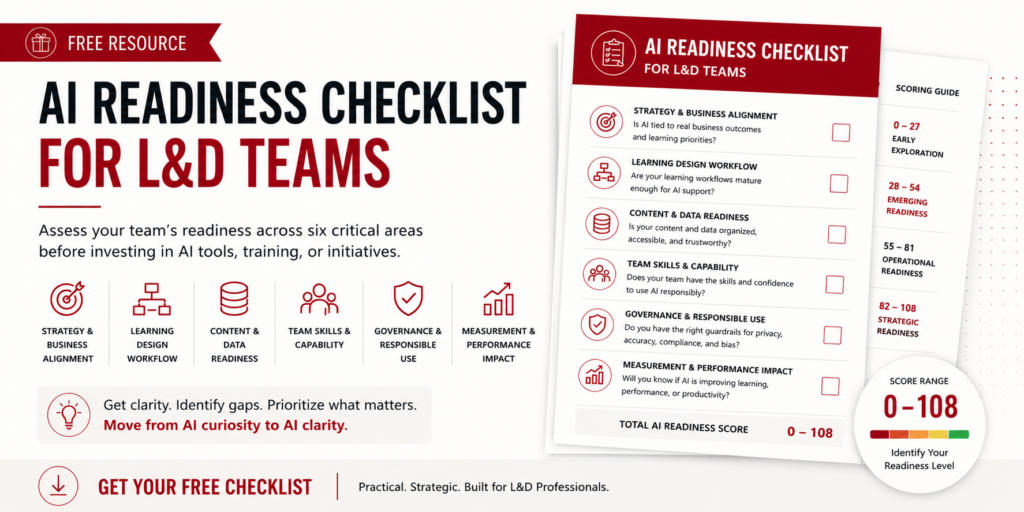
Working through what a more defensible measurement strategy looks like for your programs? The Work With Me page covers exactly that, including how to demonstrate function impact to senior stakeholders. The free AI Readiness Checklist also includes a measurement readiness component as part of the overall L&D assessment.

