

There is a pattern that shows up on almost every L&D team that starts using AI. They discover it through content production. A tool that generates a storyboard outline. A prompt that turns a policy document into a draft job aid. An AI assistant that writes quiz questions from a script in minutes instead of an afternoon. That is a real productivity gain. It is not nothing. But it is also not the end of the conversation. Too often, it becomes one.

I have been on both sides of this. I built Way One well and, for a period, mistook it for a complete AI strategy. The shift to Way Two took longer, required different organizational relationships, and surfaced governance questions I had not fully anticipated. That experience is what this post is actually about.
The teams that stop at content production are using AI to make L&D faster. The teams that go further are using AI to make learning more useful. That is a different ambition. It requires a different question about where AI actually belongs.
There are two ways to use AI in L&D. Most teams have found the first one. The second one is harder, and it is where the real impact lives.
The First Way: AI as Content Production Accelerator
This is the use case that conference sessions demonstrate, vendor decks feature, and L&D LinkedIn posts celebrate. And for good reason: it is tangible, fast, and genuinely useful.
AI as a content production accelerator looks like this:
- Generating a first draft from a SME transcript or source document
- Creating storyboard shells, module outlines, and learning objective sets
- Producing role-based variations of the same base content
- Writing quiz questions, scenario prompts, and reflection activities
- Repurposing a long course into a microlearning series, job aid, or manager guide
- Drafting communications, facilitator guides, and participant materials
The value here is real. Administrative burden drops. First drafts arrive faster. SME review cycles start earlier. Practitioners spend less time on production and more time on design decisions, stakeholder alignment, and quality review. But there is a risk worth naming.
AI as a content accelerator makes a content factory faster. That is only valuable if the factory was building the right things to begin with. If the underlying problem is too much content, hard-to-find resources, or learning that never reaches application, AI-assisted production makes those problems bigger. Not smaller.
Speed amplifies what is already there. If what is already there is misaligned with actual performance needs, you will get there faster and at higher volume. This does not mean content production is the wrong use case. It means it is an incomplete one.
The Second Way: AI as Performance Support
The second use case is less visible, harder to implement, and less likely to show up in a vendor demo. It is also where AI can create the most meaningful change in how people actually perform.
Instead of sitting in an authoring tool, AI as performance support sits in the workflow. Instead of helping the practitioner build content, it helps the employee do their job. The common thread: AI is closer to the moment of performance.
People do not build confidence by completing learning. They build it through practice, feedback, and support close to real work. Performance support AI is what makes that possible at scale.
What This Looks Like — From Easiest to Hardest to Implement
Not all performance support AI is equally complex to build. Here is a rough progression, from lowest to highest implementation burden:
- Lowest complexity: Reflection prompts embedded in a workflow — someone processes what just happened and what they would do differently next time. No system integration required. Low governance burden. Accessible to most teams now.
- Moderate complexity: Conversation simulators and AI coaching tools — a financial advisor practices a client planning discussion before having it live; a manager prepares for a difficult feedback conversation. Controlled environment, no real-time data access. More accessible than most teams assume.
- Higher complexity: AI assistants that answer employee questions in real time, using approved, current, governed source content. Requires a retrieval architecture and content governance process before the tool can be trusted.
- Highest complexity: Decision-support tools embedded directly in the workflow — surfacing the right product guidance or compliance consideration at the moment an employee needs it. Highest governance burden. Highest impact when done well.
If you are new to Way Two, start at the lowest complexity level that addresses a real gap. A well-designed reflection prompt that changes what people do after a difficult interaction is more valuable than a poorly governed AI assistant that answers questions inconsistently.
The gap between completing training and performing well is where most L&D programs lose their impact. Employees finish the course, pass the quiz, and return to the job. Then they are on their own. Performance support AI changes that equation at whatever level of complexity you can actually sustain.
Why Most Teams Are Stuck on Way One
This is not a criticism. It is a pattern worth understanding, because the reasons are structural — and knowing the structure is how you work around it.
The Core Reason: L&D Doesn’t Own the Workflow
Performance support requires being embedded in or adjacent to the actual work. That means knowing what employees do at the moment they need help, where they break down, and what information they need in that specific moment. It also means building relationships with operations, IT, compliance, and line managers that most L&D functions have not historically needed.
Most L&D teams are upstream of the work. They design programs that prepare people for work. That is a different organizational position than designing support that travels with people through work. Way Two requires the second position. Getting there is an organizational and political challenge, not just a technical one.
This is the reason teams stay on Way One longer than they intend to. It is not that they lack interest in performance support. It is that the relationships and access required to do it well take time to build.
Way One Is More Visible and Easier to Justify
Content production results are easy to demonstrate. A module that took two days instead of two weeks is a concrete win. Performance support ROI is real but harder to tell in a slide. It lives in behavior change, error reduction, and time-to-competency data that most teams are not yet set up to capture.
The Tools Favor Way One
Most AI tools marketed to L&D are authoring tools, content generators, or translation platforms. They are built for content production. Genuine workflow-embedded performance support requires integration with other systems, governance over source content, and a deeper understanding of where employees actually need help. None of it comes packaged in an authoring tool.
Way One Produces Quick Wins; Way Two Requires Positioning
Quick wins matter in organizations. They build credibility and create space for more ambitious work. Content production AI is a reasonable starting point. The problem is when it becomes the destination rather than a step toward something more strategically valuable.
AI in Regulated Environments: A Different Set of Stakes
For teams in financial services, insurance, pharma, and government, performance support AI carries a layer of risk that content production AI does not. This is where the implementation bar rises significantly, and where the governance work has to come before the build.

In FINRA-regulated financial services, for example, supervisory training obligations require firms to maintain documented, auditable records of training activities. A performance support tool that gives a registered representative real-time product guidance is not just a learning design problem. If it surfaces inaccurate, incomplete, or out-of-scope information, the consequence is a compliance event, not a course revision.
That raises three specific requirements before any performance support AI goes live:
- Source content governance: The content the tool draws from must be current, approved, and maintained. This is not a one-time project. It is an ongoing process with clear ownership.
- Defined scope boundaries: The tool needs explicit limits on what it can and cannot answer. Ambiguous scope in a regulated environment creates liability, not flexibility.
- Human review in the loop: For high-stakes guidance (product recommendations, compliance determinations, supervisory decisions) the AI should support the human decision, not replace it. The review process needs to be designed before deployment, not retrofitted after.
This does not mean performance support AI is off the table in regulated environments. If anything, the need is greater: advisors, agents, and compliance staff often need guidance at the exact moment a client is in front of them, not six weeks earlier in a compliance course.
But the work to get it right is real. Content governance and stakeholder alignment comes first. The tool comes second.
One Question to Ask Before You Choose a Direction
The shift from content production to performance support does not start with a tool decision. It starts with a question about the work itself.
Where in the work do people break down and how close can AI get to that moment?
Not where do they struggle in training. Not where do they score lowest on an assessment. Where, in actual work, do they hesitate, make avoidable errors, or ask the same questions repeatedly? Those are the signals for where performance support is needed.
Once you have an answer to that question, the next check is whether your content is in a state where a tool can use it reliably. Current, approved, organized. If it is not, that work comes before the tool.
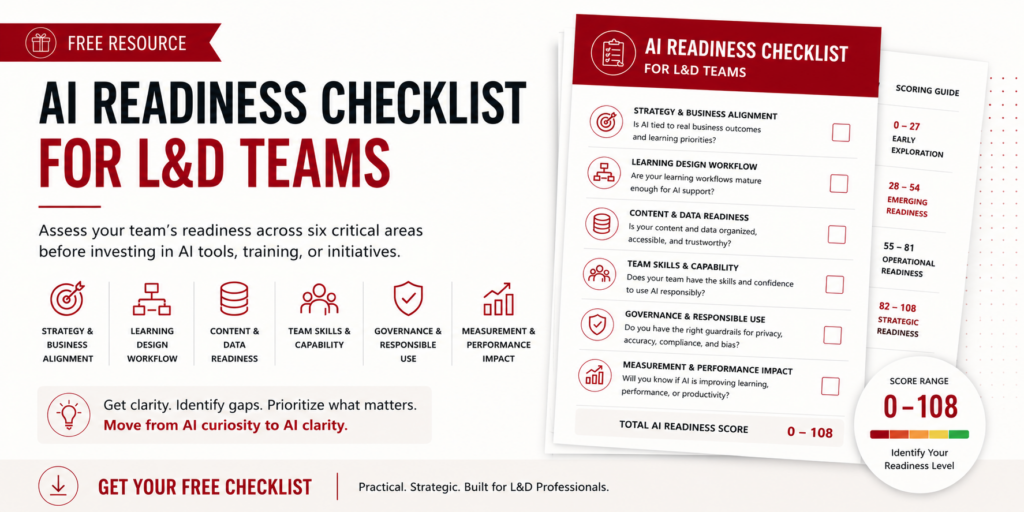
If you are not sure where your team stands across strategy, workflow, content governance, capability, and measurement, the AI Readiness Checklist covers all six dimensions and takes about fifteen minutes to complete.
The Distinction That Matters
AI as a content production accelerator and AI as performance support are both legitimate use cases. They are not in competition. But they are not the same, and treating them as if they were is how organizations end up using AI to produce more content that still does not change how people perform.
The thing worth remembering: speed amplifies what is already there.
If your L&D function is well-positioned to support performance, AI makes it more powerful. If it is not, AI makes the content output higher and the gap more visible. Way One is faster. Way Two is closer to the work. The best L&D teams use AI in both directions, with a clear view of which problem each is solving.
The question is not just whether you are using AI. It is where you are using it, and whether that is the right place for the problem in front of you.